
everything you ever wanted to know about manta rays
Learn all about the gentle giants of the ocean
Types of rays and manta rays
Classification
- Kingdom: Animalia
- Phylum: Chordata
- SubPhylum: Vertebrata
- Class: Chondrichthyes = cartilaginous fish
- Subclass: Elasmobranchii = fish that give birth to live progeny
- Superorder: Batoidea = rays
- Order: Myliobatiformes
- Family: Myliobatidae
- Subfamily: Mobulinae = manta rays and mobula rays
- Genus: Manta
- Type Species: Mobula Birostris (oceanic manta), Mobula Alfredi (reef manta), and Mobula Yarae (Atlantic manta)
Other types of rays (not to confuse them with)
In the family of rays, manta rays are the largest ones.
Manta rays are very closely related and often confused with stingrays, eagle rays, bat rays, cow rays, etc.

Manta rays vs stingrays: key differences explained

A Guide to the Different Types of Rays in Hawaii

The Difference Between Eagle Rays, Stingrays and Manta Rays
The difference between reef mantas, giant mantas, and Atlantic manta rays
There are three types of mantas: reef mantas (Mobula alfredi), pelagic manta rays (Mobula birostris), and Atlantic mantas (Mobula yarae), the latter officially described in 2025. The pelagic manta ray is also called “giant manta ray” or “oceanic manta ray”, or sometimes “the great manta ray”.
Oceanic mantas are larger and migratory – whereas reef mantas are smaller (but still huge!) and live in shallower coastal habitats.
To understand how these species developed, it helps to look at manta ray evolution over millions of years.

All About the Mysterious Giant Manta Ray

Get to Know the Majestic Reef Manta Ray

Atlantic manta ray: science confirms third species
General characteristics of manta rays
What do manta rays look like?
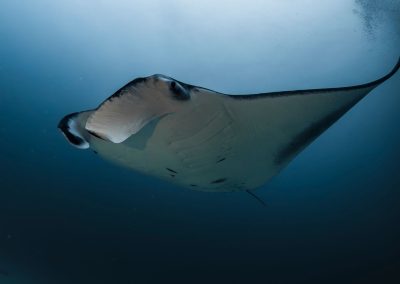
Manta rays have large, triangular-shaped pectoral fins on either side of their body, which look like wings when they swim.
They have a flattened, diamond-shaped, disk-like body. Reef manta rays are primarily gray and black on the top (dorsal side), and mostly white on the bottom (ventral side), with patches of black pigmentation.
The patches of black spot patterns, as well as other unique physical characteristics, allow us to identify and monitor individual manta rays over time. Most of the manta rays are given a name when we first identify them. Several organizations keep track of manta rays and their movement worldwide; we keep our own database of manta rays spotted around Kona in Hawaii.


How big are manta rays?
Adult reef manta females measure up to 12-14 feet (from wingtip to wingtip). Mature males are smaller, up to 10 feet.
Giant oceanic manta rays can have a wingspan of up to 22 feet wide. A picture of unknown origin from 1920 shows a manta ray that measured approximately 30 feet. Learn more about how big manta rays can grow here.
We can only estimate how much manta rays weigh; depending on the gender and the type (giant or reef manta), most would weigh between 50 and 100 lbs (between 22.5 and 50 kilos) per foot of manta ray.
How old can manta rays get?
The lifespan of a manta ray is believed to be between 50 and 100 years of age – there is so much we don’t know about them yet!
We do hope our efforts in tracking and monitoring the manta rays around Hawaii over time will help uncover more of their mysteries,
One example is Lefty, an adult manta that has been spotted in Hawaii for a duration of over 45 years.

The fascinating anatomy of manta rays

The skin of manta rays: slimy suits with built-in armor

How Can You Tell Individual Manta Rays Apart?
Are manta rays social creatures?
Manta rays seem to be solitary creatures, coming together only to feed and mate.
When they do get together, magic happens: manta rays developed intricate techniques both for mating and feeding.
Are manta rays dangerous?
Manta rays are gentle giants. They don’t have a stinger, and they don’t pose a threat to humans. Their size might be intimidating, but their only defense is speed and agility – they glide gracefully through the water, using their large pectoral fins to make quick bursts and escape predators. Their movements are not only essential for survival, but have even inspired engineering innovations.

How Manta Rays’ Movements Are Inspiring the Future of Engineering

Why Manta Rays are the Gentle Giants of the Ocean

10 Fun Facts about Manta Rays
Where are mantas on the food chain?
Manta rays are filter feeders, consuming plankton and small fish. While they’re near the top among plankton predators, they’re still prey for larger sharks and orcas. Their size, speed, and agility help them stay safe. They also play an important role in keeping plankton populations balanced in the ocean ecosystem.


manta ray reproduction
Are manta rays fish or mammals?
For the longest time, the world thought that manta rays were cetaceans – marine mammals. However, manta rays are definitely fish and not mammals.
Mantas do have some characteristics of cetaceans, though; they have the largest brain-to-body ratio of all fish, and they are better at problem-solving and communicating than your average fish.
Manta rays are cartilaginous fish in the subclass Elasmobranchii, and close relatives of the shark. Elasmobranchii give birth to live young, but that doesn’t make them mammals; they do produce eggs, and the egg gets fertilized and hatches inside their body.
How do manta rays mate and reproduce?
Manta rays have a very slow reproduction rate; they become sexually mature sometime between the age of 10 and 15, their gestation period takes about 12-13 months, and they give birth to one live pup at a time.
Manta rays have some pretty intricate courtship rituals. While they are generally solitary animals, they do get together to mate.
How are manta ray pups born?
Manta ray females give birth to a live pup. The young are almost exact replicas of the adult form, just smaller.
At birth, the pups appear cigar-shaped with the two pectoral fins rolled around them like a burrito. Reef mantas are about 2 to 3 feet across shortly after birth; pelagic manta pups measure up to 6 feet.
We were lucky enough to witness and document the development of a baby manta ray, whom we named Kamala Ray – you can read her story here.
An adult manta female doesn’t care for their pup after birth, as they are not paternal animals. This means that after birth, the pups are on their own.

How do Manta Rays Reproduce?

Are manta rays fish or mammals? Do they lay eggs?

Decoding The Life Cycle of Manta Rays – and Our Role in Their Survival
the feeding habits of manta rays
Mantas filter-feed on plankton. Their diet consists of copepods, mysid shrimp, crab larvae, mollusk larvae, and fish eggs. A manta ray will eat approximately 12% of its body weight in plankton per week.
Mantas filter the plankton out of the water using a complex system of traps, filters, cephalic fins, and gill rakers.
They swim slowly and twirl gracefully when they eat; their large mouths open, and their cephalic horns unroll to funnel the plankton into their oral cavity.


What and How do Manta Rays Eat?

The Manta Ray Cyclone: a Feeding Frenzy Phenomenon

8 Unique Techniques Manta Rays Use for Filter-Feeding
The habitat and migration patterns of manta rays
Where can we find manta rays in the wild?
Reef mantas mostly live along the coastlines in the Indo-Pacific zone, while the giant manta roams all the world’s major oceans.
Fun fact: according to scientific studies, manta rays from different oceans have the same mitochondrial DNA.
Great places to see manta rays in their natural habitat are Indonesia, the Philippines, the Maldives, Mozambique, Costa Rica, Mexico, Ecuador, Australia, Micronesia, Ecuador, Fiji, Japan, and the Solomon Islands.
As you can see, manta rays are located all over the world – and every place is unique and offers a slightly different experience.
Can we visit manta rays in aquariums?
As manta rays can’t stop swimming (and their size alone is massive), they require huge tanks. Because of this logistical hurdle, there are only four places in the world that are adequate to keep mantas in captivity: the Atlantis Resort in the Bahamas, the Okinawa Churaumi Aquarium in Japan, the S.E.A Aquarium in Singapore, and the Georgia Aquarium in Atlanta, GA.
The most challenging aspect is feeding: as mantas would continuously swim and twirl as they eat, it’s hard to replicate those circumstances in an aquarium.
So far, there have been no studies to determine if manta rays in captivity suffer any health or other issues due to their confinement. The Atlantis Resort has been successful in releasing manta rays back into the wild; watch the video (and read more about mantas in aquariums) on this page.

Behind the Scenes: How Georgia Aquarium Gives Manta Rays an Annual Check-up

Where to Find Manta Rays in the Wild Around the World

Where to See Manta Rays in Aquariums
Migration patterns of manta rays
There are clear behavioral differences between the three known types of manta rays, especially when it comes to their migration patterns.
Giant manta rays are highly migratory and are often referred to as “pelagic” mantas. Instead of staying in one area, they move across large stretches of open ocean, following plankton blooms and seasonal changes. Their movements are less predictable, which makes them harder to study and less commonly seen in consistent locations.
Reef manta rays, on the other hand, tend to stay within a specific home range and return regularly to the same feeding and cleaning sites. A great example is the “Kona family” on the Big Island of Hawaii. These reef mantas are most frequently observed at three main areas around Kona, where they come to feed at night.
The migration patterns of the Atlantic manta ray are still being studied. It has been seen across a large part of the Atlantic Ocean, from Florida all the way down to South America. Scientists believe it may behave a bit like both reef and giant mantas, meaning it could stay in certain areas but also travel longer distances at times.
In terms of how deep manta rays can swim, scientific observations show that coastal manta rays can dive deeper than 700 feet (214 m) for short periods, but they spend most of their time in shallower waters. Scuba divers and snorkelers usually encounter them between the surface and about 80 feet.
Tracking manta rays: how researchers follow the gentle giants

Tracking the Movement Patterns of Reef Manta Rays in Hawaii

Movement Patterns of Reef Manta Rays
Swimming with manta rays
What’s the best place to see manta rays in Hawaii?
The Kona Coast on the Big Island of Hawaii is home to three viewing sites where mantas come to feed at night, with a 60-80% sighting chance on a night dive at those sites.
In Maui (another Hawaiian island), Olowalu Reef has a solid population of mantas, but it is not as accessible and frequently visited with boats as the Kona coast. There is a “cleaning station” that they frequent during the daytime, but there’s no guarantee to see them.
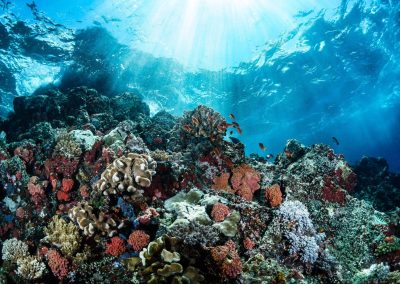
Inside the coral reefs, natural habitat of the reef manta

How Behavioral Conditioning leads Manta Rays to Feed at Manta Viewing Sites

The 3 Manta Ray Viewing Sites in Kona, Hawaii
Snorkeling with manta rays
Snorkeling with manta rays in Hawaii can be a transformational experience that truly touches you. Since the activity takes place at night, when mantas gather to feed on plankton, it’s important to be prepared and meet a few prerequisites to stay safe and enjoy the experience. If you are thinking of swimming with manta rays in Hawaii, download this guide with everything you need to know about this activity.

Beneath the Surface: The Risks of Snorkeling with Manta rays at Night

8 Essential Safety Tips for Snorkeling with Manta Rays

Swimming with manta rays: what you need to know before diving in
The downsides of manta ray tourism
Snorkeling and diving tours with manta rays can offer a great alternative to less sustainable economic activities like fishing to local communities. If you want to dive deeper into this, read this article on how manta rays boost local economies.
But ocean tourism is not without its risks: in the absence of clear regulations and enforcement, viewing sites can become overcrowded and local crews sometimes resort to activities that can injure the mantas and/or damage other marine life in the vicinity.

Cutting Corners: Tourist Boat Practices that Harm Humans and Mantas

The Dark Side of Manta Ray Tourism: the Impact of Ecotourism on People, Mantas, and the Environment

Are Manta Ray Expeditions Harmful to Manta Rays?
The threats manta ray face – worldwide and in Hawai’i
How many mantas are left in the world?
No one really knows how many manta rays are left in the wild. The database of mantas around the Big Island of Hawaii contains about 320 individual manta rays; however, this catalog was started in the early 90s, and there’s no way to know how many of the manta rays in the database are still alive at this time.
The Manta Trust recently identified the 5000th manta in the Maldives since they started keeping a database. But again, it’s hard to know if they’re all still alive to this day.
Since December 2020, the giant (oceanic) manta is classified as “endangered” on the IUCN Red List, while the reef manta is labeled “vulnerable with decreasing numbers”.
Why are manta rays endangered?
Since manta rays don’t have many predators in the wild, humans are their greatest threat. Ocean pollution, fishing, and unregulated ecotourism are the most important activities that cause harm to the gentle giants.

Why is it Important to Protect Manta Rays?

Ocean Plastic Pollution and Its Deadly Effect on Manta Rays

Protecting Manta Rays in Hawaii
What can we do to protect manta rays from extinction?
Swimming with manta rays is a life-changing experience and we hope it will be available to many generations to come. Besides, we need more time to discover more about the mysterious mantas.
Read more below about the different ways you can contribute – by supporting ocean conservation organizations, by speaking up and voting for better legislation, and by taking action yourself.

7 Ocean Conservation Charities We Love and Support

5 Things You Can Do (Right Now) to Save the Ocean and Protect Marine Life
